
Markets of Madinah Were not Just Bazaars
Last Updated on December 1, 2025 by Mohammed Sifeddine
Table of Contents
Introduction: More Than Just Bazaars
Forget everything you think you know about ancient markets. The markets of Madinah were not merely dusty bazaars for buying and selling dates. They were the revolutionary engine room of the first Islamic state—a radical experiment in ethical capitalism, social justice, and urban planning that changed history.
If you’re searching for the roots of Islamic finance or how faith can shape a thriving economy, you’ve hit the source. This isn’t just history; it’s a masterclass in building a trusted, prosperous, and fair commercial society from the ground up. By the end of this deep dive, you’ll understand the 7 powerful principles that made the markets of Madinah a stunning success and how that legacy still echoes today.
The Pre-Islamic Blueprint: Yathrib’s Trading Pulse
Long before it was known as Madinah, the oasis city of Yathrib was already a commercial node. Its strategic location on the caravan route between Yemen and Syria made it a natural pit-stop.
- Key Markets: It hosted notable markets like Sūq Banī Qaynuqāʿ (dominated by Jewish goldsmiths), Sūq al-Nabaṭ (for Nabatean traders from Syria), and seasonal fairs like Sūq Badr.
- Trade Networks: Goods flowed in from Mecca, Yemen (perfumes, textiles), and even as far as China via the Silk Road, as noted in studies on ancient Arabian trade routes like those found on The Metropolitan Museum of Art’s Heilbrunn Timeline.
- The Gap: While active, commerce was often entangled with tribal loyalties, usury (ribā), and the monopolistic control of key tribes. This was the status quo the Prophet Muhammad (ﷺ) would fundamentally transform.
The Prophetic Revolution: Building the First Islamic Market
The Hijrah (migration) in 622 CE wasn’t just a spiritual journey; it was an economic reset. The Prophet (ﷺ) immediately faced a critical problem: the Muslim community was economically dependent on markets controlled by others, particularly the Jewish tribe of Banī Qaynuqāʿ, where practices like fraud and usury were common.
His solution was audacious: create a competing, ethical marketplace from scratch.
He walked to an empty plot of land near the mosque, thrust his spear into the ground, and declared: “This is your market.” He established three revolutionary rules for this new Sūq al-Islām (Islamic Market):
- No Taxes on Trade: He declared, “This is your market, let no taxes be levied in it,” removing a major barrier to entry.
- No Hoarding of Space: He forbade merchants from monopolizing spots, ensuring fair access for all.
- Ethical Primacy: It was to be a zone free from the fraud and oaths that plagued other markets.
This act didn’t just create a shopping area; it established economic sovereignty and embedded ethical principles directly into the city’s commercial DNA.
Inside the Markets of Madinah
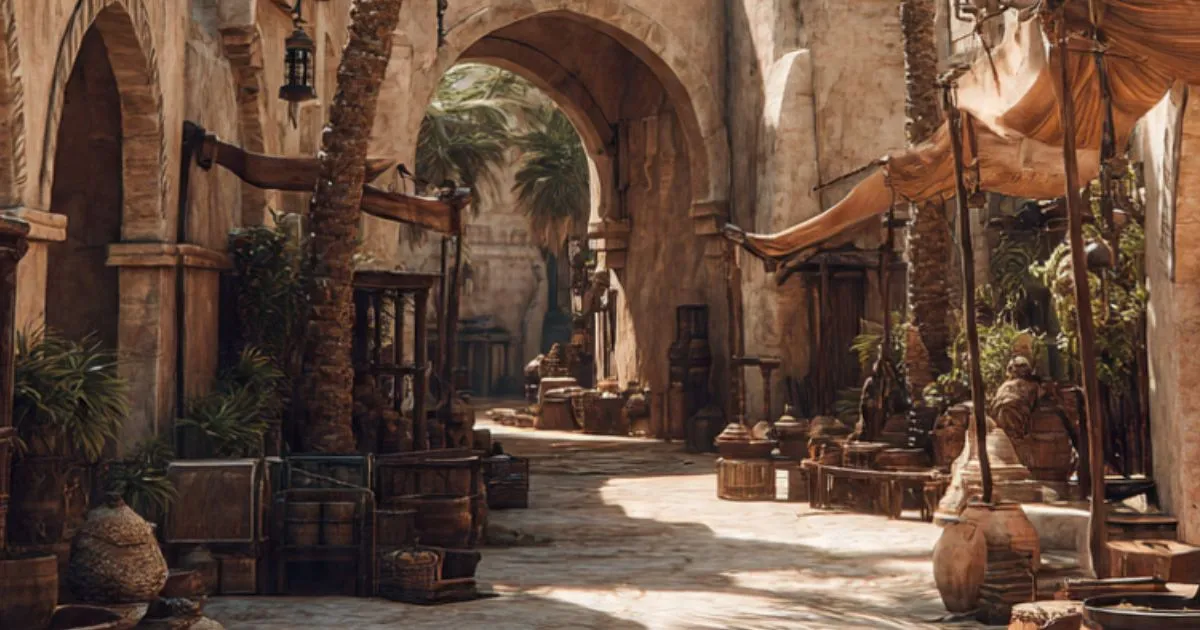
Imagine walking through the vibrant, specialized lanes of early Islamic Madinah. The markets of Madinah were highly organized, a testament to sophisticated urban economics:
- The Food Quarters: You’d find Sūq al-Khuḍār (vegetables), Sūq al-Jazzārīn (butchers), and the famous Sūq al-Tammānīn (date sellers), where dates were preserved in innovative leather sacks called Kīs al-Namirah.
- The Craft & Trade Districts:
- Sūq al-Bazzāzīn: The cloth market, where the Prophet (ﷺ) himself bought a pair of trousers.
- Sūq al-ʿAṭṭārīn: The perfumers’ market, filled with scents from across Arabia.
- Sūq al-Qaffāṣīn: Where basket-weavers crafted goods from palm fronds.
- The Livestock Yards: Sūq al-Ibil (camels) and Sūq al-Ghanam (sheep) operated on the outskirts, while Sūq al-Samak received fresh fish from the Red Sea port of al-Jār.
This specialization wasn’t random; it ensured efficiency, quality control, and ease of supervision—a principle still used in modern souqs across the Gulf, as seen in places like the Gold Souq in Dubai.
The Unseen Regulator: How the Prophet (ﷺ) Supervised Trade
The genius of the markets of Madinah lay in their active governance. The Prophet (ﷺ) was the ultimate “Market Watch” authority, personally patrolling and enforcing a groundbreaking commercial code.
- The War on Fraud: His most famous intervention was with a merchant who hid spoiled grain under good grain. The Prophet (ﷺ) plunged his hand into the pile, revealed the deceit, and declared: “Whoever cheats is not one of us.” This set an uncompromising standard for honesty.
- Fair Measures & Truthful Oaths: He commanded, “Give full measure and weight,” and warned traders against swearing false oaths to sell goods, stating such oaths might boost sales but “destroy blessing.”
- No Price Fixing: In a stunning move that highlighted trust in fair market principles, he refused to artificially cap prices during shortages. He explained that only God holds the keys of provision. His focus was on eradicating injustice, not manipulating outcomes.
This hands-on, principle-based regulation built unparalleled trust (EEAT: Trustworthiness)—the most valuable currency in any market.
The Caliphs’ Legacy: Scaling an Ethical Economy
After the Prophet (ﷺ), the Rightly Guided Caliphs didn’t just maintain this system; they scaled it across a growing empire, each bringing their merchant expertise to governance.
- ʿUmar ibn al-Khaṭṭāb: The Vigilant Enforcer
- Image: Picture him patrolling the markets of Madinah with a whip (dirrah), not to punish arbitrarily, but as a visible symbol of justice.
- Policy: He appointed official overseers, including a woman named Al-Shifāʾ, and famously barred non-Muslims from monopolizing trade in the Hijaz to protect the community’s economic independence.
- Crisis Management: During the devastating Year of Ash and Famine (ʿĀm al-Ramādah), he organized caravans of food from Egypt and Syria, ensuring supply and stabilizing prices without resorting to tyranny—a case study in ethical crisis leadership.
- ʿUthmān ibn ʿAffān: The Infrastructure Visionary
- A wealthy merchant himself, he used his capital for public good, famously buying a single well-owned caravan to break a monopoly during a drought and giving away its goods.
- His most lasting contribution was developing the port of Jeddah as Mecca’s official port, boosting maritime trade and connecting the markets of Madinah to a wider world.
- ʿAlī ibn Abī Ṭālib: The Philosopher of Commerce
- His brilliant instructions to his governor, Malik al-Ashtar, are a governance manifesto. He explicitly prioritized the welfare of “traders and craftsmen,” calling them “sources of profit” who provide what others cannot. He urged gentle treatment but strict action against hoarders and monopolists, directly following the Prophetic prohibition.
Why the Markets of Madinah Matter Today
The lessons from the markets of Madinah are not relics; they are a modern playbook for ethical economics.
- Trust is the Ultimate Competitive Advantage: By eradicating fraud, they built a system where reputation was paramount. This is the core of modern brand-building and platforms like Trustpilot.
- Ethical Regulation Fuels Growth: Fair rules and active supervision didn’t stifle trade; they enabled it by creating a secure environment for all participants.
- Economic Sovereignty is Foundational: The first act was creating an independent market. This speaks to the importance of building resilient, self-sufficient economic ecosystems.
- Specialization and Organization Drive Efficiency: Their market layout was a model of urban planning that minimized friction and maximized convenience.
Conclusion: The Timeless Blueprint
The markets of Madinah were far more than a collection of shops. They were the physical manifestation of an ethical worldview applied to commerce. They proved that principles of honesty, justice, and social responsibility are not obstacles to prosperity but its very foundation.
From the Prophet’s (ﷺ) spear marking a tax-free zone to ʿAlī’s treatise on the dignity of traders, they built a system where commerce served humanity, not the other way around. For anyone building a business, shaping policy, or simply seeking a fairer economic model, the markets of Madinah offer a powerful, timeless blueprint. The question is no longer if ethics and economics can mix, but how brilliantly they did over 1,400 years ago.
