
The Beauty of Ablaq Architecture: The 700-Year-Old Secret of the Prophet’s Mosque
Last Updated on September 7, 2026 by Mohammed Sifeddine
Table of Contents
The Beauty of Ablaq Architecture: The 700-Year-Old Secret of the Prophet’s Mosque
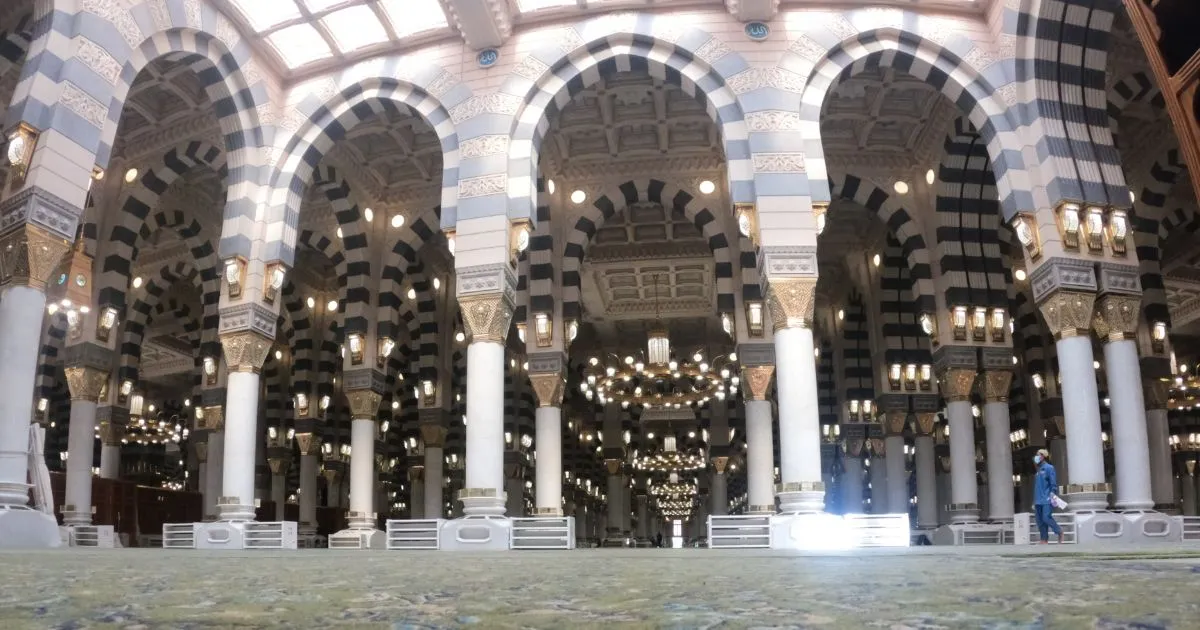
Ablaq architecture is not merely a decorative style; it is the visual heartbeat of one of Islam’s holiest sites. If you have ever stood in the Prophet’s Mosque in Medina, captivated by the rhythmic interplay of light and dark stone on its walls and arches, you have witnessed a legacy that has silently narrated tales of devotion, artistry, and royal patronage for over seven centuries. This is the story of how a simple, powerful pattern became an immortal part of the mosque’s identity, weaving together history, spirituality, and unparalleled aesthetic genius.
1. What is Ablaq Architecture? From Language to Stone
The term ‘Ablaq’ finds its roots in classical Arabic language. Scholars of old used it to describe something piebald or particolored—most commonly, a horse or a bird with a striking coat of alternating black and white. It was a word that captured beautiful contrast.
Then, the architects arrived. They took this word from the world of nature and biology and forged it into a cornerstone of Islamic architectural decoration. Ablaq architecture is defined by the alternating use of light (often white or beige limestone) and dark (black basalt, grey granite, or red sandstone) stone courses in masonry. This technique transforms static walls and arches into dynamic, rhythmic canvases. It’s a visual melody where color and structure perform in harmony, creating an unforgettable impression of both solidity and grace. This principle became a defining feature in Levantine Islamic architecture, seen in masterpieces from Jerusalem to Damascus.
2. The Phoenix Rises: The Mamluk Resurrection and the First Sacred Ablaq
The Ablaq architecture in Medina has a definitive birth moment born from tragedy and reverence. In 654 AH (1256 CE), a devastating fire swept through the Prophet’s Mosque, damaging its sacred structure. The community of Medina united for its restoration, but it was the arrival of the Mamluk sultans that would permanently change its aesthetic destiny.
The Mamluks, renowned for their architectural prowess and military precision, approached the expansion and renovation with what can only be described as sacred awe. As they worked near the Holy Chamber (Hujrah) of the Prophet (peace be upon him), their Ablaq architecture was an act of devotion. They clad the ancient marble in new, reverent layers, using white marble and red “sammaq” stone. They understood they were working on the most sacred ground on Earth, and the result was sublime. The alternating colors mirrored the intertwining feelings of awe and love that fill a visitor’s heart.
Under Sultan Qaitbay, Ablaq architecture became pronounced. Look up at the upper arches surrounding the Rawdah today. You will see white and black stones in perfect succession, like measured heartbeats of light and shadow—a pattern documented by scholars like Al-Samhudi over five centuries ago. Furthermore, the Qaitbay Minaret, standing at the mosque’s forefront, is not just a tower; it is a vertical masterpiece of Ablaq architecture. Its alternating white and red bands are so vibrant one almost expects the muezzin to emerge and begin the call to prayer.
3. The Ottoman Touch: Refining Elegance in the Rawdah
The Ottoman Empire, heirs to a vast architectural legacy and masters of intricate ornamentation, continued the Ablaq tradition with a distinct sensitivity. When they added their contributions, such as the exquisite Ottoman Mihrab and the Suleymaniye Mihrab, they incorporated Ablaq architecture with a gentle touch.
Their approach was one of harmony. They preserved the spiritual essence of the space without overpowering it. The Ottoman Ablaq often features white marble alongside grey and black stones, arranged with the refined elegance of an ornate Ottoman fabric wrapping the mosque in a dignified embrace. This period demonstrated how Ablaq architecture could adapt, maintaining its core identity while absorbing the stylistic nuances of a new era, a testament to its timeless flexibility.
4. The Saudi Expansion: Honoring Heritage with a Modern Vision
The modern, large-scale Saudi expansions of the Prophet’s Mosque presented a monumental challenge: how to preserve profound historical identity while building for the future on a colossal scale. The goal was clear—to maintain and enhance the mosque’s beauty without losing its authenticity.
The answer, once again, was Ablaq architecture. The modern architects revived this ancient motif, clothing it in contemporary materials. Look at the vast arches resting on columns in the new areas. They are clad in artificial stone, adorned with scattered pieces of white and grey Ablaq patterning. It is as if the columns themselves declare: “We are the extension of our Mamluk and Ottoman forebears, but we are built for today.”
Stand before the King Abdulaziz Gate to the east or the King Saud Gate to the west. You are greeted by three grand arches per gate, crowned with alternating bands of white and black stone. This modern Ablaq architecture is a welcoming announcement, bridging the beauty of the past with the grandeur of the present.
5. More Than Stone: The Spiritual Resonance of the Pattern
To reduce Ablaq architecture to mere aesthetic technique is to miss its soul. Over centuries, it has transcended decoration to become a form of visual spirituality. In the context of the Prophet’s Mosque, the pattern carries deep symbolic weight.
The interplay of light and dark can be seen as a metaphor for the human condition—the constant dialogue between clarity and uncertainty, sin and forgiveness, shadow and divine light. The rhythmic, unending pattern reflects the eternal nature of the message of Islam and the perpetual devotion offered at this site. It teaches that beauty itself can be an act of worship when dedicated to the house of God’s Messenger (peace be upon him). As one historical account cited by the Qatar Digital Library notes, architectural choices in holy sites were deeply considered for their spiritual and communal impact.
6. Witnessing Ablaq Architecture Today: A Visitor’s Guide
When you next visit the Prophet’s Mosque, let your eyes seek out the Ablaq narrative:
- At the Rawdah: Gaze upward at the arches surrounding the blessed garden. This is the heart of the historical Ablaq.
- The Qaitbay Minaret: Observe its vibrant, striped facade near the Bab as-Salam gate.
- The Ottoman Mihrabs: Find the detailed, refined Ablaq work within their niches.
- The Modern Gates and Arcades: Appreciate how the pattern scales to monumental size at the main entrances and throughout the new courtyards.
Each band of stone is a line in a 700-year-old poem written in granite and marble, a continuous thread of care that connects every Muslim who has contributed to the mosque’s splendor.
Conclusion: An Eternal Dialogue in Stone
From the marble of the Prophet’s chamber to the grand domes of the Ottomans and the soaring gates of the modern expansion, Ablaq architecture has been the constant visual thread. It is a small architectural element that carries the immense weight of history, geometry, art, and spirituality. It is a quiet, powerful language spoken in light and shadow, telling all who see it that this place is, and has always been, the object of the Muslim world’s most loving attention. It proves that true heritage is not frozen in time but is a living, breathing tradition that grows more profound with each passing century.
Internal Links:
- Learn more about the history of the Prophet’s Mosque expansions.
- Explore the detailed Islamic architecture and History of Masjid nabawi
External Dofollow Links:
- For an in-depth academic study on Mamluk architecture, see the work hosted by the Metropolitan Museum of Art’s Heilbrunn Timeline.
- Historical chronicles like those of Al-Samhudi are preserved and discussed in collections accessible through the King Saud University Digital Library.
