
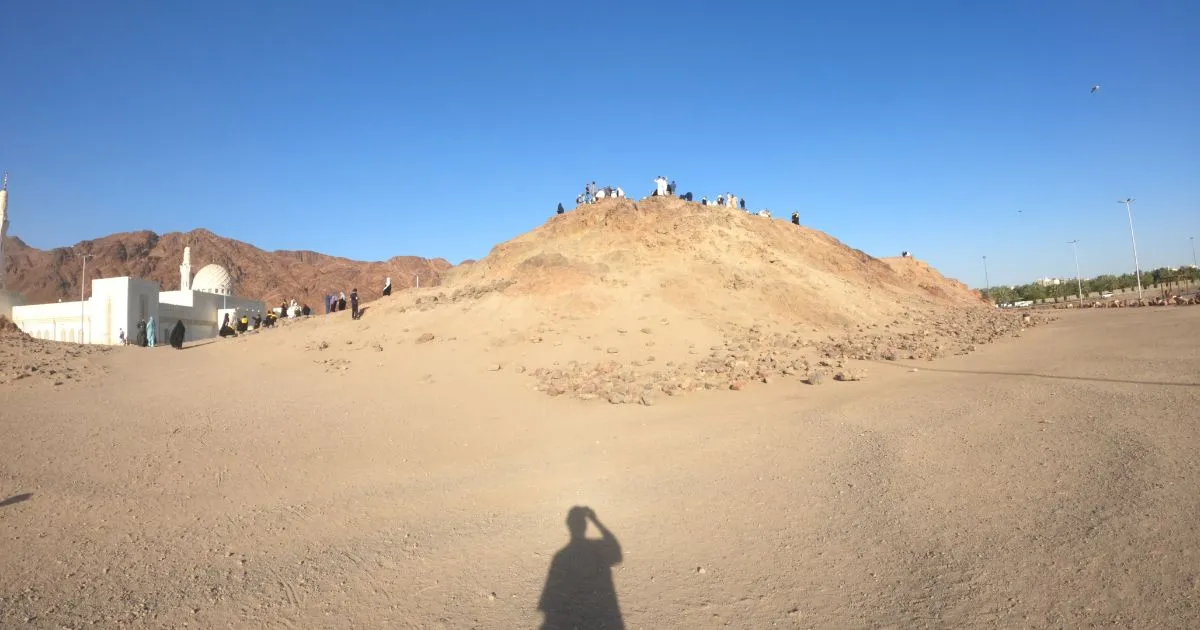
Jabal al-Rumah: The Mountain That Witnessed a Turning Point in Islamic History
Last Updated on January 10, 2026 by Mohammed Sifeddine
Table of Contents
Jabal al-Rumah: The Mountain That Witnessed a Turning Point in Islamic History
Jabal al-Rumah, also known as Jabal ‘Aynain, is far more than a simple hill on the outskirts of Medina. It is a silent, enduring witness to one of the most critical and instructive battles in Islamic history: the Battle of Uhud. This mountain stands as a monumental landmark, not just in the physical landscape of the city, but in the spiritual and historical consciousness of the Muslim world. The events that unfolded here in 3 AH (625 CE) offer timeless lessons on strategy, discipline, faith, and the consequences of disobedience. This deep dive explores the geography, history, and enduring legacy of Jabal al-Rumah.
1. The Strategic Significance of Jabal al-Rumah in the Battle of Uhud
To understand Jabal al-Rumah, one must understand the Battle of Uhud. The Prophet Muhammad (peace be upon him), faced with a large Meccan army seeking revenge for their defeat at Badr, positioned the Muslim forces with Mount Uhud behind them. He identified a key tactical vulnerability: a small mountain pass that could be used to outflank his army.
This pass was guarded by Jabal al-Rumah.
The Prophet (pbuh) placed a company of fifty skilled archers, under the command of Abdullah bin Jubair (RA), on Jabal al-Rumah. Their orders were explicit and absolute: “Protect our backs from the cavalry. Do not leave this post. If you see us prevailing, do not join us. If you see us being overwhelmed, do not come to our aid.”
Initially, the plan worked flawlessly. The archers on Jabal al-Rumah rained arrows down on the Meccan cavalry, thwarting every attempt to attack the Muslims from the rear. The Muslim army gained the upper hand, and the Meccans began to retreat. Seeing the tide of battle turn and the enemy camp filling with valuables, most of the archers on Jabal al-Rumah believed the battle was won.
Despite their commander’s desperate pleas, they abandoned their post, disobeying the Prophet’s direct order to secure the spoils of war. This single act of disobedience had catastrophic consequences. The Meccan cavalry commander, Khalid bin Walid (who later converted to Islam), saw the mountain pass undefended and launched a devastating flanking attack. The battle’s momentum reversed entirely, leading to severe Muslim casualties, including the tragic martyrdom of Hamza ibn Abdul-Muttalib (RA), the Prophet’s beloved uncle.
Thus, Jabal al-Rumah transformed from a pillar of victory into a symbol of a painful, hard-learned lesson in unity and obedience.
2. The Two Names: Jabal al-Rumah and Jabal ‘Aynain
This historic mountain is known by two primary names, each telling part of its story:
- Jabal al-Rumah (جبل الرماة): The Mountain of the Archers. This is the most common and historically resonant name, derived directly from the event that made it famous. It is a name that echoes through Islamic history books and is instantly recognizable to students of the Seerah.
- Jabal ‘Aynain (جبل عينين): The Mountain of the Two Springs. This older name is believed to refer to two water sources that were present in the area. Historians like Al-Samhudi (d. 1506 CE) suggested it was named for the “Qantarat al-Ayn” (Bridge of the Spring) and the “Ayn al-Shuhada” (Spring of the Martyrs) located near its base. The linguistic structure of ‘Aynain—the dual form of ‘Ayn (spring)—directly points to this geographical feature.
Prominent Medinan historian Abdul Quddus Al-Ansari supported this view, noting that the confluence of these two water sources likely gave the mountain its original name. This dual naming convention beautifully captures the site’s essence: a geographic feature defined by its water sources, forever renamed by its history.
3. Geographic Location and Features
Jabal al-Rumah is located in the northern part of Medina, approximately 5 kilometers north of the Prophet’s Mosque. It is a small, distinct hill that forms the southern extension of the larger Mount Uhud complex.
Key landmarks in relation to Jabal al-Rumah include:
- North: The shrine of Hamza ibn Abdul-Muttalib (RA) and the cemetery of the martyrs of Uhud.
- West/Northwest: The historic plains that were the main battlefield.
- Surrounding Area: The course of Wadi Qanat (also called Wadi Hamza), which historically separated the mountain from the martyrs’ cemetery.
For centuries, the area retained its rugged, desert-like character, helping visitors visualize the battle. However, significant urban development in the late 20th century covered much of the plains with asphalt and infrastructure. Modern preservation efforts, led by the Royal Commission for Al-Ula and the Agency for the Development of Medina, now focus on restoring the site’s historical integrity, removing intrusive construction, and creating a dignified visitor experience that allows for reflection on the sacred ground. You can learn more about Saudi Arabia’s historic preservation projects on the official Saudi Heritage Commission website.
4. Monuments and Landmarks On and Around the Mountain
The area surrounding Jabal al-Rumah is one of Medina’s richest in historical landmarks:
- Masjid al-Masra’ (The Mosque of the Martyrdom Site): Located on the eastern ridge of Jabal al-Rumah, this small, roofless mosque marks the spot where Hamza (RA) is believed to have been martyred. Some narrations suggest the Prophet (pbuh) prayed over his uncle here. It is a simple structure of stacked stones, preserved in its essential form.
- The Second Mosque: North of Masjid al-Masra’, another site is indicated as the spot where Hamza (RA) finally fell.
- The Martyrs’ Cemetery (Shuhada’ Uhud): The final resting place of Hamza (RA) and over 70 other companions martyred in the battle.
- Masjid Sayyidina Hamza: Also known as Masjid al-Askar, located east of the cemetery, where the Prophet (pbuh) is said to have led the Fajr prayer before the battle.
- Ayn al-Shuhada (Spring of the Martyrs): A historic spring dug by Marwan bin Hakam during the caliphate of Muawiyah (RA) to provide water for the area.
5. The Modern Transformation and Preservation Efforts
For decades, Jabal al-Rumah and the Plains of Uhud were encroached upon by informal housing and urban sprawl. The mountain itself was covered in old dwellings, obscuring its form and the view of the battlefield.
Recognizing the site’s immense historical and spiritual value, Saudi authorities undertook a major project to reclaim and rehabilitate the area. This involved:
- Removing all non-historical structures from the mountain and the central battlefield.
- Clearing the plains to restore the visual connection between Jabal al-Rumah, Mount Uhud, and the martyrs’ cemetery.
- Developing a master plan for visitor facilities, pathways, and signage that respects the sanctity of the location while accommodating the millions of pilgrims and visitors who come each year.
The goal is to allow modern visitors to contemplate the history of Jabal al-Rumah in an environment that echoes, as closely as possible, the conditions of that fateful day.
6. The Eternal Lessons from the Mountain
Jabal al-Rumah is not merely a tourist destination; it is a teacher. The core lesson it imparts is the paramount importance of obedience to legitimate command within a collective framework. The archers’ individual decision, though seemingly logical in the moment of perceived victory, broke the chain of command and cost the community dearly.
This mountain teaches us about:
- The Fragility of Victory: How success can be undone in an instant by a lapse in discipline.
- The Importance of Strategic Posts: Every role in a collective mission is crucial, especially the unseen, defensive ones.
- The Cost of Disunity: A lesson that transcends military history and applies to communities, organizations, and nations.
When you stand before Jabal al-Rumah today, you stand before a monument to memory. It asks every visitor a silent question: In the pursuit of your own immediate gains, are you abandoning a post critical to the greater good? The echo of that question, first heard over 1400 years ago, is the true, enduring legacy of the Mountain of the Archers.
For more insights into the historic sites of Medina, explore our guide to Mount Uhud.
