
Masjid al-Fath in Madinah: History and Location
Last Updated on September 7, 2026 by Mohammed Sifeddine
Table of Contents
Masjid al-Fath in Madinah: History and Location
Masjid al-Fath is not merely a structure of stone and mortar; it is a timeless testament to faith, resilience, and divine prophecy. Located in Medina, this sacred site stands on hallowed ground where Prophet Muhammad (peace be upon him) himself pitched his tent for six days during one of Islam’s most pivotal conflicts: the Battle of the Trench (Ghazwat al-Ahzab). Known as the “Mosque of Victory,” it commemorates the divine support that led to a decisive Muslim triumph. Here, the Prophet (PBUH) led approximately 30 prayers, strategized for the Muslim community’s survival, and witnessed miracles that foretold the future expansion of the Islamic state. The current architectural marvel, built roughly 600 years ago during the era of the Umayyad Caliph Umar ibn Abdulaziz, encapsulates this profound history within its exquisite and precisely calculated Islamic design.
This article will guide you through the mosque’s gripping historical significance, its awe-inspiring architectural details, and the enduring lessons it holds for visitors and believers today.
1. The Historical Ground: Prophet Muhammad’s Strategic Command Post
The significance of Masjid al-Fath is rooted in the events of the 5th year after Hijra (627 CE). Facing a confederation of over 10,000 enemy troops—the “Ahzab” or Confederates—the outnumbered Muslims of Medina adopted a novel defensive strategy: digging a massive trench north of the city.
Prophet Muhammad (PBUH) established his command center on a rocky hillock where Masjid al-Fath now stands. For six critical days, this spot was the nerve center of the entire operation. From here, he:
- Led the Muslim community in prayer.
- Oversaw the grueling work of digging the trench.
- Directed military logistics and morale.
- Made the heartfelt du’a (supplication) that ultimately led to the enemy’s defeat, as mentioned in the Quran (33:9).
This strategic vantage point, now sanctified within the Mosque of Victory, symbolizes divinely guided leadership in the face of overwhelming adversity.
2. A Testament to Faith: The Battle of the Trench and Its Martyrs
The Battle of the Trench was a severe test described in the Quran as a moment when “the believers were shaken with a mighty shaking” and “hearts reached the throats” (33:10-11). Despite the fear and hardship, the Muslims’ unwavering faith held firm.
The victory, however, came with the profound sacrifice of shuhada (martyrs). Masjid al-Fath honors the memory of the six companions who were martyred in this battle, a testament that victory in the path of Allah sometimes carries a heavy cost. Among them was the noble Sa’d bin Mu’adh (RA), leader of the Aws tribe, whose death was of such significance that it is narrated the Throne of the Most Merciful shook for him. His funeral was attended by 70,000 angels, a powerful account preserved in hadith collections like Sahih al-Bukhari.
Remembering their sacrifice at the site where the battle was commanded adds a deep, poignant layer to a visit to the Mosque of Victory.
3. The Site of a Miracle: The Splitting of the Rock and Prophecy
One of the most extraordinary events associated with Masjid al-Fath is the miracle of the splitting rock. As narrated by the companion Al-Bara’ bin ‘Azib (RA), while digging the trench, the Muslims encountered an immovable boulder. Prophet Muhammad (PBUH), upon being informed, took up a pickaxe, declared “Bismillah” (In the name of Allah), and struck.
With the first strike, a third of the rock split off. He (PBUH) proclaimed, “Allahu Akbar! I have been given the keys to Syria. By Allah, I can see its red palaces at this moment!”
A second strike broke another third. He (PBUH) said, “Allahu Akbar! I have been given the keys to Persia. By Allah, I can see the white palace of Madain right now!”
The final strike shattered the remaining rock. He (PBUH) declared, “Allahu Akbar! I have been given the keys to Yemen. By Allah, I can see the gates of Sana’a from this very place!”
This miraculous event, occurring at the very site of Masjid al-Fath, was a divine prophecy. The conquests of Syria, Persia, and Yemen unfolded exactly as foretold during the reigns of the Rightly Guided Caliphs, fulfilling a vision seen from the Mosque of Victory.
4. Architectural Marvel: Decoding the 600-Year-Old Design of Masjid al-Fath
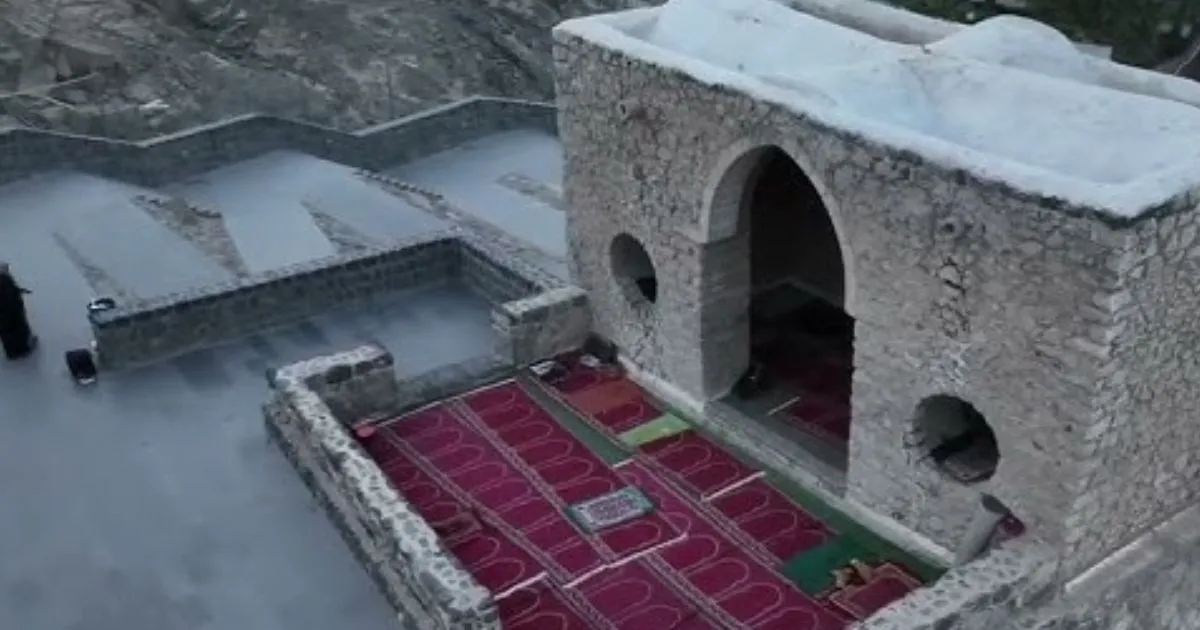
While the original site dates to the Prophet’s time, the current stone structure of Masjid al-Fath is a masterpiece of later Islamic architecture, commissioned approximately 600 years ago by the renowned Umayyad Caliph and governor of Medina, Umar ibn Abdulaziz. Its design is a deliberate and precise homage:
- Symmetry and Symbolism: The architecture employs profound geometric precision. For instance, eight stones from the black Hijr (basalt) on one side are meticulously matched by eight on the other. This balance reflects the Islamic principles of harmony and order.
- The Arches: Each arch in the Mosque of Victory is constructed with exactly 18 stones, mirrored by the arch opposite it. This repetition creates a rhythm that is both aesthetically pleasing and symbolic of steadfastness.
- Enduring Craftsmanship: The precise stone paving (رصف) and placement speak to the high level of architectural skill and intention, meant to create a lasting sanctuary.
This intentional design transforms Masjid al-Fath from a simple historical marker into a living piece of Islamic architectural heritage.
5. Visiting Masjid al-Fath Today: A Living Legacy
Today, Masjid al-Fath is part of the “Seven Mosques” (Sab’u Masajid) complex in Medina, a key destination for pilgrims and history seekers. Visiting it allows you to:
- Walk in the footsteps of history: Literally stand where the Prophet (PBUH) stood to oversee a battle that changed history.
- Reflect on resilience: Contemplate the lessons of patience, strategy, and absolute trust in Allah (tawakkul) embodied here.
- Appreciate Islamic heritage: Witness the seamless blend of profound history and architectural beauty that characterizes Islam’s holy sites.
For those planning a visit, it is recommended to learn about the Battle of the Trench in detail beforehand. Resources like IslamicFinder offer historical summaries and maps to enrich your understanding of Medina’s sacred geography.
Important Distinction: Masjid al-Fath in Makkah – The Conquest of Makkah
Not to be confused with its namesake in Medina, there is another significant Masjid al-Fath located near Makkah. This mosque commemorates a different, later, and ultimate victory: the Peaceful Conquest of Makkah (Fath Makkah) in 8 AH (630 CE).
Located in the modern-day area of Al-Jumum, approximately 20-22 km from Makkah, this mosque marks the spot in the valley of Murrat Zhahran where Prophet Muhammad (PBUH) camped with an army of over 10,000 companions from various Arab tribes during the march to liberate Makkah.
Key historical events at this site include:
- The Camp of 10,000: Imagine the awe-inspiring sight of the Prophet’s vast and diverse army camped in this valley, a powerful display of united faith.
- The Strategy of Light: The Prophet (PBUH) ordered every soldier to light a fire, creating an intimidating sea of light that filled the valley. This psychological strategy played a key role in demonstrating the Muslims’ strength.
- The Conversion of Abu Sufyan: It was here that the Quraysh leader Abu Sufyan ibn Harb, guided by Al-Abbas (RA), came to the camp, witnessed the immense army, and ultimately embraced Islam. The Prophet (PBUH) then declared his famous amnesty: “Whoever enters the house of Abu Sufyan is safe, whoever enters the Masjid al-Haram is safe, and whoever stays in his own house is safe.”
- A Center of Heritage: The area of Al-Jumum and nearby Wadi Fatimah is rich with historical sites, including the ancient Al-Akhdar Mosque (Masjid al-Mihrabayn), old fortresses, traditional mud-brick villages, and the historic Al-Aziziyah water project from the era of King Abdulaziz.
While both are called Masjid al-Fath, they honor two distinct chapters of victory: one of defensive perseverance in Medina and one of triumphant return and mercy near Makkah. For a deeper dive into the events of the Conquest of Makkah, resources like IslamicFinder provide detailed historical timelines and accounts.
6. Why Masjid al-Fath Matters More Than Ever
Masjid al-Fath—the Mosque of Victory—is far more than a historical monument. It is a multidimensional symbol of divine support following sincere effort, the price of faith, and the fulfillment of God’s promise. It reminds us that victory is not defined by numbers or weaponry alone, but by purity of intention, unity of purpose, and unwavering belief.
From the moment Prophet Muhammad (PBUH) made his du’a on this hill to the precise architectural details laid down centuries later, every element of this site tells a story of a victory that was both immediate (the dispersal of the confederate armies) and unfolding (the prophecy of future conquests).
In a modern world often defined by uncertainty and challenge, Masjid al-Fath stands as an eternal beacon, urging believers to dig their trenches of effort, stand firm in their faith, and trust in the victory that comes from Allah. It is a place where history is felt, not just learned, making it an essential spiritual and historical destination for every Muslim and seeker of truth. To further explore the rich history of Medina, you can read our guide on the Prophet’s Mosque’s History
location of Masjid Al Fath in Madinah
