
Bab Al-Anbariyah: The Hidden History of a Madinah Landmark
Table of Contents
The Hidden History of Bab Al-Anbariyah
Bab Al-Anbariyah is not just a historical footnote; it is a poignant symbol of a transformative era in Al-Madinah Al-Munawwarah. If you’re searching for a deep, satisfying understanding of this iconic structure, you’ve come to the right place. This article cuts through the noise to deliver a comprehensive exploration of Bab Al-Anbariyah—its dual phases, architectural evolution, and the profound reasons behind its disappearance. You will finish with a clear, expert-level grasp of its role in the city’s narrative, feeling confident in sharing these insights.
Let’s begin at the beginning.
Bab Al-Anbariyah I: The Original Gate
The story of Bab Al-Anbariyah begins not with one, but two distinct structures. The first gate, whose foundations are often overshadowed by its successor, was an elegant architectural piece that highlighted the skill of its designer and builders.
A fascinating later modification saw its two smaller archways sealed with stone masonry. They were converted into small rooms, likely used as dormitories for soldiers, with new, small arched entrances opened from inside the gateway complex.
This adaptation hints at the gate’s active military and administrative role in the city’s life before the 20th century’s great upheaval.
The Pivotal Shift: Why a New Gate Was Built
The complete demolition of the first Bab Al-Anbariyah and the construction of a new one several meters away was not arbitrary. It was a direct consequence of one of the late Ottoman Empire’s most ambitious projects: the Hejaz Railway.
This modern transit line, intended to connect Damascus to Madinah, required new infrastructure. The old city wall needed to be extended to encompass:
- The new Bab Al-Anbariyah gate area.
- The entrance to the railway station building.
- The dedicated Masjid Al-Anbariyah.
Building a new, strategically located gate was essential for integrating this modern transport hub into the fortified city, securing both pilgrims and logistics. For more on this transformative project, see the Our Article on the Hejaz Railway .
Bab Al-Anbariyah II: The “Hamidi” or “Rashadi” Gate
This new gate, located in the southwestern part of Madinah, carries two alternative names reflecting its Ottoman patronage:
- Bab Al-Hamidi: Named after Sultan Abdul Hamid II, who commissioned its construction as part of the Hejaz Railway project between 1319-1326 AH (1901-1908 CE).
- Bab Al-Rashadi: Named after Sultan Muhammad V Rashad, who renovated it during his reign (1328-1337 AH / 1910-1918 CE).
It stood between the iconic Masjid Al-Anbariyah and the railway station, connected westward to the city wall leading to Bab Al-Mughaisalah.
Decoding the Architecture: A Photo-Famined Analysis
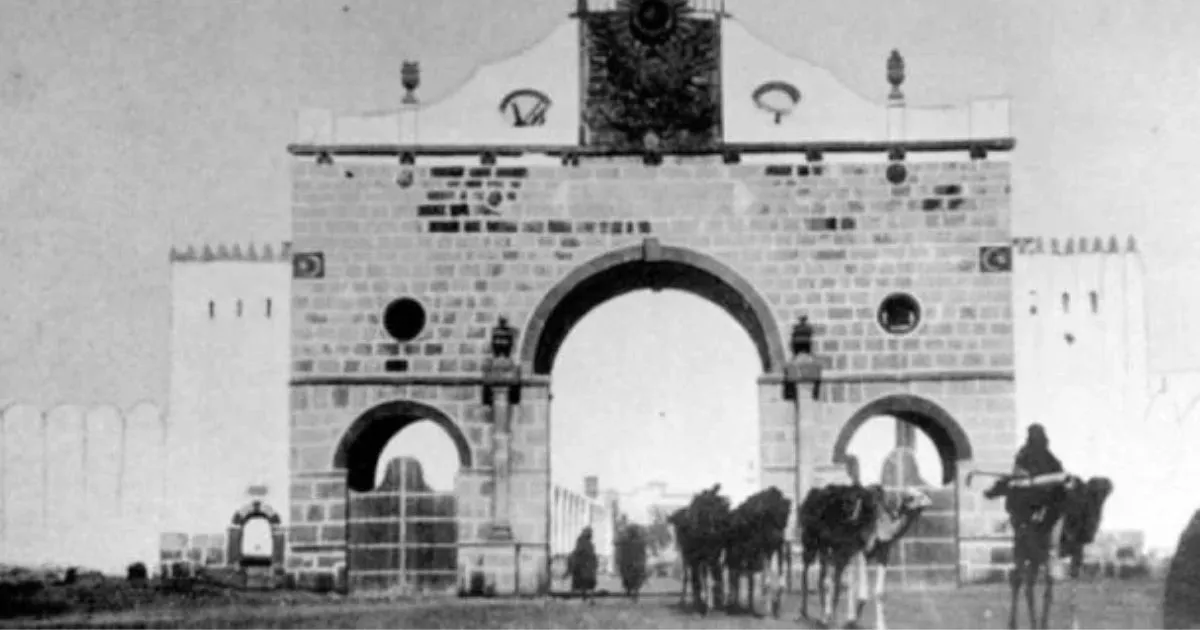
Here lies a significant historical gap: a startling lack of visual documentation. While the first gate was well-photographed, the second exists largely in a single known image. Most historical sources and travelogues from the period failed to provide detailed descriptions or photographs.
[IMAGE: A historical photo of Bab Al-Anbariyah II, if available, or an artistic reconstruction]
Alt Text: Historical architecture of the Ottoman-era Bab Al-Anbariyah gate in Madinah.
Based on available evidence, the new gate was roughly similar to the first but with distinct features:
The Main Structure:
- It consisted of three portals.
- The central, main entrance was a rectangular door topped by a semi-circular arch, narrower but taller than the first gate’s main entrance.
- The two side portals were similar semi-circular arches.
Unique Modifications:
- The side arches were blocked from the outside. Each was given a small arched entrance from inside the gatehouse, again repurposing the space as soldiers’ quarters.
- Small rectangular windows with semi-circular tops were opened on the exterior flanking these side portals.
- The top of the gate facade featured two rectangular, non-opening windows above the side arches, set back from the wall surface. These were crowned with a “motor” arch style—a signature design element used throughout the Hejaz Railway station and its associated buildings.
Crowning Feature & Materials:
- The gate was surmounted by a stone crest. The crest’s height dipped in the center of the north and south facades, creating a low, rectangular section divided into seven equal units.
- The frames were built with regular black stone, while the inner panels were made of mudbrick covered with gypsum and lime plaster.
- The gate was constructed primarily from beautiful, regular black stone quarried from the nearby Harrat (lava field), the same material used for Masjid Al-Anbariyah and the railway station itself.
From Guard Post to Ghost: The Gate’s Function and Fate
Bab Al-Anbariyah stood firm, performing its duties as the guardian of this new transport corridor, long after the original gate was removed. Its story, however, could not withstand the rapid growth of the modern Saudi state.
With security firmly established and the city expanding far beyond its ancient walls, the fortified perimeter became obsolete. Around 1370 AH (1950 CE), a project to remove the old city walls began. Bab Al-Anbariyah, along with other historic gates, was demolished to make way for the expanding urban fabric of modern Madinah.
More Than Just Stones
The journey of Bab Al-Anbariyah—from its first iteration, through its strategic relocation for the railway, to its final demolition—mirrors Madinah’s own transition from a fortified traditional city to a modern metropolis. Its architecture tells a story of Ottoman engineering, while its modifications speak to practical, daily-use needs. The haunting scarcity of its photographs reminds us how quickly physical history can vanish, making the preservation of such knowledge all the more critical.
Understanding Bab Al-Anbariyah is understanding a key pivot point in Madinah’s history, where ancient pilgrimage routes collided with modern technology, all framed within the stone of a gate that is no longer there, but whose story remains essential.