
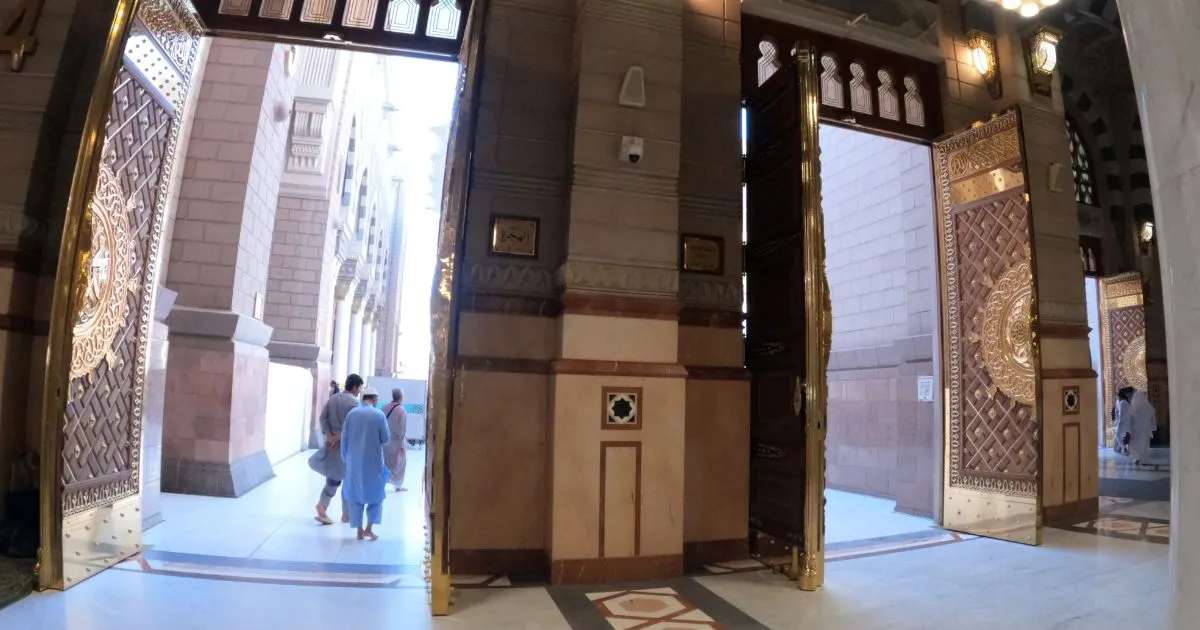
The Remarkable Story of Bab Al-Majeedi: A Historic Gate of Medina
Table of Contents
The Remarkable Story of Bab Al-Majeedi: A Historic Gateway to Knowledge
Bab Al-Majeedi is not just an architectural feature; it is a portal into the rich, layered history of Al-Madinah Al-Munawwarah. Located in the northern wall of the Prophet’s Mosque, this gate stands as a testament to practical problem-solving during a period of massive expansion and serves as the namesake for a once-thriving hub of Islamic scholarship. Its story is one of community, adaptation, and the enduring pursuit of knowledge.
This article will delve into the fascinating origins of Bab Al-Majeedi, explore the vibrant scholarly neighborhood that bore its name, and highlight its lasting legacy in the heart of the Islamic world.
The Practical Origins: Why Bab Al-Majeedi Was Opened
The story of Bab Al-Majeedi begins during the major Ottoman expansion of the Prophet’s Mosque under Sultan Abdul Hamid II. Officially opened in 1267 AH (around 1850/1851 CE), this gate was born out of a very practical and community-centered need.
During the construction, heavy carts laden with stone and massive columns entered the city through the Bab Al-Shami (the Syrian Gate). Their route took them through the internal city streets, including Shaari‘ Al-Saha, then through Bab Al-Rahmah, and finally Bab Al-Diyafah. The passage of these incredibly heavy vehicles caused severe shaking and vibrations that rippled through the densely packed houses along the path.
Fearing for the structural integrity of their homes and disturbed by the constant tremors, the residents of Medina voiced their complaints. In a direct response to this public concern, the Ottoman authorities made a decisive intervention: they opened a new gate in the northern internal wall.
This new opening, Bab Al-Majeedi, provided a direct access point from the Al-Majeedi neighborhood—an area located north of the Mosque, outside the main city wall at the time. By redirecting the construction traffic through this new gate, the disruptive procession through residential heartlands was eliminated. This act demonstrated a notable sensitivity to the welfare of the Medina community, turning a public nuisance into an innovative urban solution.
A Hub of Learning: The Bab Al-Majeedi District
The Bab Al-Majeedi gate gave its name to the entire surrounding district, an area that evolved into one of the most important centers of learning in Medina. Located north of the Prophet’s Mosque, this district was characterized by a dense concentration of educational and charitable institutions.
It was a labyrinth of knowledge, with narrow streets branching into alleys like Shaari‘ Al-Rumiyah. The air here was often filled with the sounds of students reciting the Quran, scholars teaching, and the intellectual buzz of a dedicated community. This neighborhood wasn’t just a residential area; it was an ecosystem designed to nurture the mind and spirit, attracting students and teachers from across the Muslim world.
For a deeper understanding of Medina’s urban and architectural history during the Ottoman period, resources like the Research Centre for Islamic History, Art and Culture (IRCICA) offer valuable scholarly work. You can explore their publications here (dofollow).
Pillars of the Community: Notable Institutions
The Bab Al-Majeedi district was defined by its institutions. These were not grand universities in the modern sense, but intimate, community-embedded schools, libraries, and hostels that formed the backbone of Islamic education for generations.
The Maktabs (Quranic Schools)
Education often began in the humble maktabs (Quranic schools or kuttabs), where children learned the fundamentals of faith and literacy. The district was famous for several, including those run by esteemed teachers:
- Maktab of Sheikh Abdullah bin Ahmad Al-Rifa’i Al-Hawsawi
- Maktab of Sheikh Fatima Al-Takruniyyah
- Maktab of Sheikh ‘Abidah
These institutions highlight an important and often overlooked facet of Islamic educational history: the significant role of female scholars (sheikhahs) as teachers and mentors.
Libraries and Integrated Schools
The pursuit of knowledge continued in combined library-school complexes, which housed precious manuscripts and provided advanced study spaces:
- Al-Boshnak Library: A library founded by or for the Bosniak community residing in Medina.
- Al-Wafa’iyyah School and Library
- Al-Samarqandiyyah School and Library: Pointing to connections with the scholarly traditions of Central Asia.
- Library of the Takiyyah of Amir Bukhara: Another institution reflecting the strong Transoxanian (Central Asian) influence in Medina’s scholarly circles. For more on the global network of Islamic scholarship, the British Library’s Asian and African Studies blog has explored related topics here (dofollow).
- Dar Al-Aytam (Orphanage) School and Library: Perhaps the most poignant, illustrating how education and charity were seamlessly integrated, ensuring orphaned children were cared for and educated.
The Legacy of a Gate and Its Name
Today, the physical structure of the old Bab Al-Majeedi may be gone, absorbed into the continual and vast expansions of the Prophet’s Mosque. However, its legacy is twofold and enduring.
First, it symbolizes a historical moment of pragmatic and compassionate urban planning. The gate’s very existence is a reminder that the growth of the holy sanctuary was managed with consideration for its inhabitants.
Second, and more powerfully, the name Bab Al-Majeedi evokes the memory of a vibrant intellectual quarter. It conjures images of a time when this specific area was synonymous with the rustle of manuscript pages, the discourse of students, and the dedication of teachers who shaped generations of scholars. While the modern landscape of Medina has transformed dramatically, understanding districts like Bab Al-Majeedi is crucial to appreciating the city’s rich socio-cultural tapestry beyond the Haram.
To explore more about the historical gates and expansion phases of the Prophet’s Mosque, consider reading our article on the Architectural History of Al-Masjid an-Nabawi.
In conclusion, Bab Al-Majeedi is far more than a forgotten entryway. It is a historical footnote that tells a grand story—of solving a community’s problem with a new gate, and of the flourishing center of learning that subsequently carried its name into the annals of Islamic education. It reminds us that history is often written in the details of daily life and the quiet corners where knowledge is preserved and passed on.