
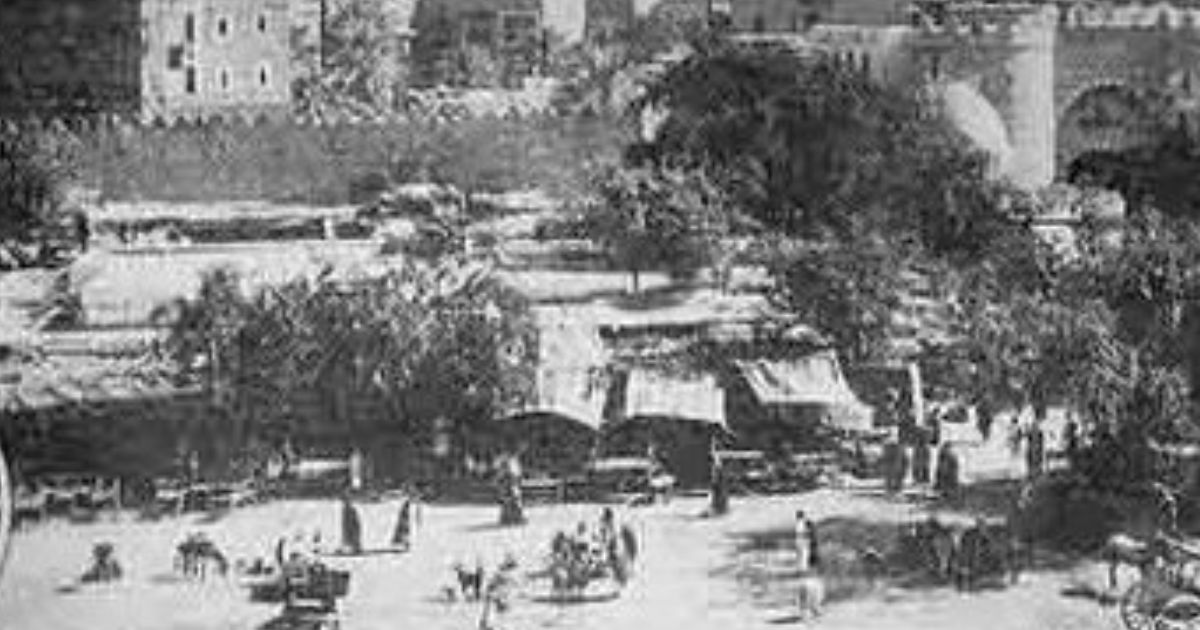
The Incredible Story of Bab Al-Masri: Madinah’s Historic Egyptian Gate
Table of Contents
The Incredible Story of Bab Al-Masri: Madinah’s Historic Egyptian Gate
The Living Gateway of Madinah
For the pilgrim or history enthusiast walking the modern streets of Madinah, it’s easy to miss the layers of the past beneath the contemporary city. Yet, certain names echo with centuries of commerce, devotion, and daily life. Bab Al-Masri, the “Egyptian Gate,” is one such name. More than just a historical footnote, Bab Al-Masri was the dynamic, bustling southwestern gateway to the Prophet’s City—a crucial nexus where trade routes converged, pilgrims entered, and history was woven into the very fabric of the old city walls. This is the story of a gate that was not merely an entrance but a vital organ in the body of old Madinah.
Bab Al-Masri: The Pivotal Crossroads of Old Madinah
Located on the western side of the first city wall, Bab Al-Masri served as the critical link between two distinct worlds. To its west lay the vibrant, market-filled district of Al-Manakhah. To its east was the area known as “Jawh Al-Madinah” (the inner city), a network of narrow commercial streets like the famed Suq Al-Qumashah (Cloth Market), historically referred to as Al-Balat Al-A’dham (The Grand Pavement).
This strategic position made Bab Al-Masri the primary conduit for movement. It connected major city districts, various markets (asuq), and public squares (mayadin), handling intense pedestrian traffic. The gate plaza itself covered approximately 6,500 square meters, functioning as a massive roundabout for its time.
Its importance is further underscored by its proximity to key landmarks:
- 320 meters from Bab Al-Salam, one of the main gates of the Prophet’s Mosque.
- Bordered to the south by the historic Masjid Al-Musalla.
- Featuring the old Municipality Building at its northeastern corner.
Suq Al-Hababah: The Grand Commercial Artery
Feeding directly into the plaza of Bab Al-Masri was the magnificent Suq Al-Hababah. This was not a narrow alley but a grand, purpose-built commercial street:
- Dimensions: 20 meters wide and 90 meters long.
- Function: The main market street of Al-Manakhah, lined with shops (“dukakin”) hosting a multitude of commercial activities.
- Pathway: It began within the Al-Manakhah district and terminated at the wide-open plaza before Bab Al-Masri.
This design made Suq Al-Hababah the principal feeder of goods and people into the gate area, a broad boulevard of commerce in an era of narrower passages.
A Network of Trade: The Three Paths from the Plaza
The plaza facing Bab Al-Masri was not a dead end but a distribution hub. From this open space, three key streets branched out, connecting the gate to the rest of Madinah’s commercial labyrinth:
- Southward: Suq Al-Ayyashah.
- Northward (Two Parallel Streets):
- One leading to Suq Al-Haraj (the auction or livestock market).
- The other connecting to Shar’e Fatima, a street that itself branched into numerous other specialty markets.
Passing through Bab Al-Masri itself led one into Al-Suwayqah—the main commercial corridor that served as the final pathway for pilgrims and goods heading toward the sanctuary of the Prophet’s Mosque (Al-Haram).
The Historical Evolution of Bab Al-Masri
The story of Bab Al-Masri is a journey through Islamic architecture and urban development. Its origins are humble yet ancient.
- The First Wall (263 AH / 876-877 CE): The gate’s history begins with the first fortified wall around Madinah, commissioned by Isaac bin Muhammad bin Ja’far bin Abi Talib Al-Ja’fari, the city’s appointed Emir under the Abbasid Caliph Al-Mu’tamid. Initially, it was a simple, modest opening in a wall made of mud brick (libn).
- Ottoman Renovation (939 AH / 1532 CE): A major reconstruction was undertaken by order of the Ottoman Sultan Suleiman bin Selim. During this period, it was known as Bab Al-Suwayqah, named after the market it led into. This renovation gave it a stronger, more substantial foundation.
- The Muhammad Ali Pasha Era (Early 19th Century CE): The gate received its lasting name following significant reconstruction ordered by Muhammad Ali Pasha, the powerful Ottoman Wali (Governor) of Egypt, during the reign of Sultan Mahmud II (1223-1255 AH / 1808-1839 CE). In honor of this patronage, it was renamed Bab Al-Masri (“The Egyptian Gate”).
From Bab Al-Musalla to Bab Al-Masri: A Timeline of Renaming
The gate’s nomenclature reflects its history and surroundings:
- Bab Al-Musalla: Its original name, derived from its proximity to the Masjid Al-Musalla in the Al-Manakhah area.
- Bab Al-Suwayqah: The name used during the Ottoman renovations, highlighting its function as the gateway to the main market corridor.
- Bab Al-Masri: The name that endured from the 19th century onward, commemorating the Egyptian patronage of Muhammad Ali Pasha.
A Gate of Ceremony: The Entry of the Mahmal
Beyond daily commerce and pilgrimage, Bab Al-Masri held deep social and ceremonial significance. It was the traditional entry point for the magnificent Al-Mahmal Al-Masri.
The Mahmal was a ceremonial palanquin carried by a dedicated caravan from Cairo. It did not carry pilgrims but was a symbolic empty litter draped with a rich covering (Kiswah), part of which was the sacred Kiswat Al-Ka’bah (covering for the Kaaba in Makkah) and often included a cover for the Sacred Tomb (Al-Rawdah Al-Sharifah) in the Prophet’s Mosque.
The annual arrival of this splendid procession through Bab Al-Masri was a major event, symbolizing the deep spiritual and political ties between Egypt and the Holy Cities. You can learn more about the history and significance of the Kiswah at the official King Abdulaziz Complex for Kaaba Kiswah.
Bab Al-Masri in the Modern Era
With the demolition of the old city walls in the 20th century to accommodate expansion, Bab Al-Masri, like other gates, ceased to function as a physical barrier. However, its legacy is actively preserved.
In the contemporary period, the Madinah Municipality (Amanat Al-Madinah Al-Munawwarah) has undertaken careful conservation and restoration projects to highlight and maintain this crucial historical site. While the urban landscape has transformed, the location and memory of Bab Al-Masri remain a focal point for understanding Madinah’s historical urban layout. For authoritative information on historical sites in Madinah, visitors can refer to the Saudi Heritage Commission.
More Than Stone and Mortar
Bab Al-Masri stands as a powerful testament to Madinah’s identity as a living, evolving city of faith and community. It was never just an arch in a wall. It was the confluence point of Suq Al-Hababah’s commerce, the starting point of Suq Al-Ayyashah, and the guardian of the path to Al-Suwayqah and the Prophet’s Mosque. It witnessed the daily flow of residents, the yearly influx of pilgrims, and the majestic ceremony of the Egyptian Mahmal.
To understand Bab Al-Masri is to understand the interconnectedness of spiritual journey, economic life, and urban planning in historic Madinah. It reminds us that the city’s heart beat not in isolation, but through its gates—and Bab Al-Masri was one of its strongest, most vital pulses. For the modern visitor, seeking out its location is to stand at a crossroads of history, where the echoes of countless footsteps, from humble traders to royal caravans, still seem to resonate.
Read More about Madinah in our Blog Section