
The Martyrs of Uhud: Complete Guide to Their Stories & Graves
Table of Contents
The Martyrs of Uhud: Complete Guide to Their Stories & Graves
Where the “Alive with Their Lord” Rest
On the red-earth plains at the base of Mount Uhud lies a cemetery unlike any other. Here, the soil cradles heroes whose stories define sacrifice, and whose status was clarified by the Quran itself: “And do not say about those who are killed in the way of Allah, ‘They are dead.’ Rather, they are alive, but you perceive [it] not.” (Quran 2:154). This is the resting place of the martyrs of the Battle of Uhud—a place of profound sorrow, eternal hope, and living history. Based on historical accounts from scholars like Ibn Ishaq and the recent fieldwork of “Ma’alam wa Athar Al-Madinah,” this guide uncovers their stories and shows you how to visit with reverence.
The Supreme Martyr: Hamzah ibn Abdul-Muttalib (RA)
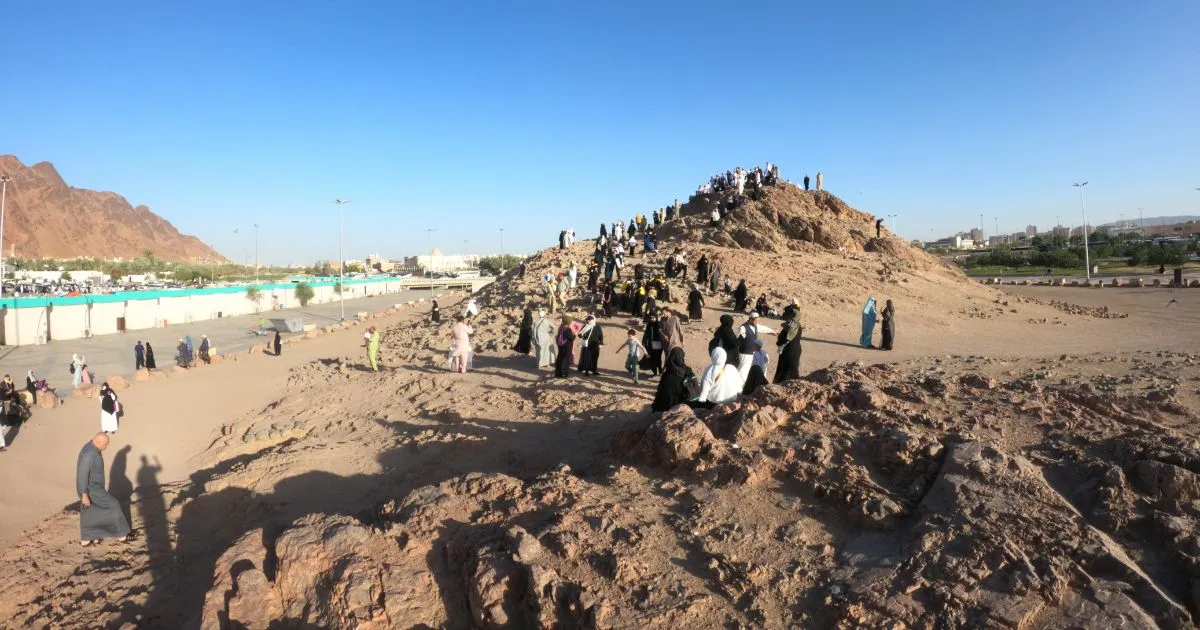
Location: Historical sources, , indicate Hamzah (RA) was martyred east of Mount ‘Aynain (now called Mount Ar-Rumat), the strategic hill where the archers were stationed.
His Story & Martyrdom:
Hamzah, the Prophet’s beloved uncle and the “Lion of Allah,” was targeted. Wahshi, an enslaved Abyssinian spear-thrower, was promised freedom by his master, Jubayr ibn Mut’im, if he killed Hamzah to avenge his uncle’s death at Badr. Wahshi later recounted, as referenced by our guides: “I came to the battle with no aim except Hamzah.” Using his skill, he hurled his spear, striking Hamzah (RA) mortally. Hind bint Utbah, in her rage over her father’s death at Badr, committed a grievous mutilation after his martyrdom.
The Prophet’s Grief: Finding his uncle’s body desecrated was the most painful sight for the Prophet (PBUH). His profound sorrow led him to declare, “I will never be afflicted with a calamity like yours again.” Hamzah (RA) was buried on the battlefield where he fell.
The Steadfast Defender: Abdullah ibn Jubair (RA)
Location: He was the commander of the 50 archers stationed on Mount ‘Aynain. He fell at his post, defending the very position the Prophet (PBUH) had ordered him never to leave.
His Story & Martyrdom:
Ibn Jubair (RA) was given a crystal-clear command: protect the Muslim army’s rear flank from the mountain pass. When the battle seemed won and the archers saw their companions gathering spoils, they pleaded to descend. Ibn Jubair reminded them of the Prophet’s orders, but most deserted. He and a handful remained. It was then that Khalid ibn al-Walid’s cavalry exploited the gap. Ibn Jubair (RA) and his few loyal men fought ferociously. Our guide, referencing Al-Waqidi, described his end: “He fought a terrible fight… until his bow was broken by the barrage of arrows.” He was overrun and martyred at his post, a symbol of obedience unto death.
The Unshaken Companions Around the Prophet (PBUH)
As the tide turned, a small group formed a human shield around the injured Prophet (PBUH). Our guides named among them Talhah ibn Ubaydullah (RA), Sa’d ibn Abi Waqqas (RA), and devoted Ansar. The narration states: “The Ansar, all of those who were with the Prophet, were killed defending him at the feet of the Messenger of Allah (PBUH).”
- Talhah ibn Ubaydullah (RA): He shielded the Prophet (PBUH) with his own hands, which were left paralyzed from the arrows and strikes he absorbed. The Prophet (PBUH) later said, “Whoever wishes to see a martyr walking on the face of the earth, let him look at Talhah ibn Ubaydullah.”
- Mus‘ab ibn ‘Umayr (RA): The standard-bearer who was mistaken for the Prophet (PBUH). He held the flag until both his hands were severed, then embraced it with his arms until he was killed.
Finding Strength in the Aftermath: Other Notable Martyrs
- Anas ibn An-Nadr (RA): Hearing the rumor that the Prophet (PBUH) was martyred, he declared, “What is the joy of life after him?” He plunged into the enemy ranks, fighting until he was martyred. Later, he was recognized only by a distinctive mark on his fingertips. The Prophet (PBUH) confirmed he had indeed “smelled the fragrance of Paradise from beyond Uhud.”
- Hanzalah ibn Abi ‘Amir (RA): Known as “Hanzalah the Purified” (Al-Ghasil), he was martyred in a state of marital purity (janabah) as he had left his home for battle immediately after his wedding night. The angels themselves were said to have washed his body for burial.
The Martyrs’ Cemetery: Location & Visiting Etiquette Today
Exact Location: The cemetery is located at the direct foothills of Mount Uhud, a short walk from the main parking and visitation area. It is distinct and well-signposted.
How to Visit with Respect:
- Intention (Niyyah): Visit to draw lessons, send prayers (du’a), and remember the hereafter, not as mere tourism.
- Prayer (Du’a): Stand respectfully and make du’a for them. The Prophet (PBUH) would visit and say, “Peace be upon you for your patience. How excellent is your final abode!” You can say: “As-salamu ‘alaykum yā ahl al-qubūr, yaghfirullāhu lanā wa lakum” (Peace be upon you, O people of the graves. May Allah forgive us and you).
- Reflect, Don’t Disturb: Speak softly. Do not tread on the graves or lean on the low walls.
- Send Blessings on the Prophet (PBUH): Do this abundantly, for he was the leader they died defending.
The Ultimate Lesson: Divine Forgiveness After Disobedience
The most profound lesson from Uhud is encapsulated in the Quranic verse recited by our guide from Surah Aal ‘Imran (3:152): “…And Allah has already forgiven you…” The Muslims had erred. Orders were disobeyed. A calamity occurred. Yet, Allah SWT announced His forgiveness. The martyrs attained the highest rank. The survivors were forgiven and taught a lesson for eternity. This is the mercy that surrounds the ground of Uhud.
Visit, and leave with two convictions: a heart broken for the love these companions had for their faith, and a heart swelling with hope in the boundless forgiveness of Allah.
External Resources (Dofollow):
Internal Links:
- Read about the strategic mistakes that led to this tragedy in our article: What happened in The battle Uhud ?
- Understand the spiritual significance of the mountain watching over them: Mount Uhud’s Secret: Why Prophet Muhammad ﷺ Said ‘It Loves Us’.