
Navigating Women Restrooms and Current Maintenance at Al-Masjid an-Nabawi
Table of Contents
Your Essential Access Guide
For every pilgrim visiting the blessed city of Madinah, access to clean and convenient facilities is a fundamental part of a comfortable spiritual journey. Women restrooms at Al-Masjid an-Nabawi are a primary concern for female visitors and families. Currently, with ongoing maintenance work in the holy month of Shaban, knowing exactly where to go is more crucial than ever. This guide provides a clear, firsthand, and updated overview of all accessible women’s restrooms at Al-Masjid an-Nabawi, focusing on the northern courtyards, to ensure your visit is smooth and focused on worship. Read our other article about Women Prayer Areas at Masjid Nabawi: Access Guide
Current Maintenance & What Pilgrims Must Know
As of Shaban (2024), the administration of the Prophet’s Mosque is conducting significant maintenance on restroom facilities. This work is essential for ensuring hygiene and comfort for millions of visitors, especially ahead of Ramadan. However, it has temporarily affected availability.
The most critical update for all pilgrims is this: Major maintenance is concentrated on the Basement Level (Levels A and B) accessible via the main escalators in the northern courtyards. These basement levels are currently closed for renovation. Pilgrims descending via these escalators will find these facilities unavailable and often encounter unnecessary crowding.
- Actionable Advice: Avoid the main escalators for restroom access. Instead, use the staircase systems to reach Level 1 (the First Floor), which remains fully open and operational with significantly less crowding.
Women’s Restrooms at Al-Masjid an-Nabawi: Primary Northern Area Locations
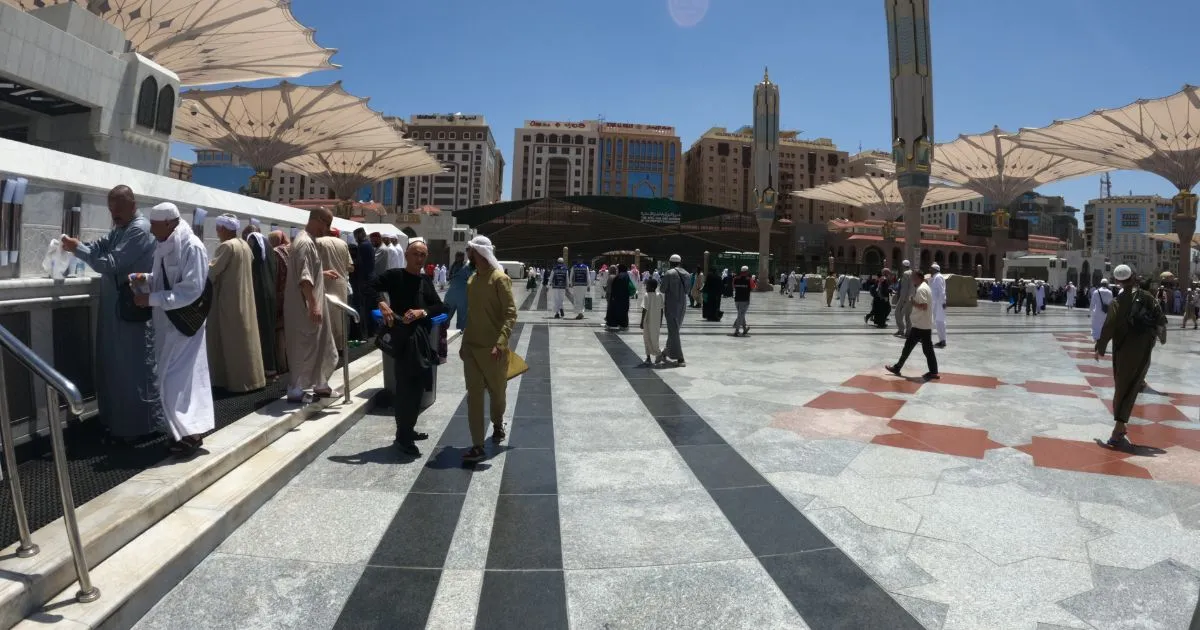
Navigating the vast northern courtyards can be overwhelming. Based on recent, on-ground verification, here are the specific and currently operational locations for women restrooms at Al-Masjid an-Nabawi in this area.
Contrary to what some may assume, not all restroom entrances in the northern courtyards are for men. It is vital to identify the correct gates to avoid confusion and save valuable time.
The two primary and confirmed access points for women are:
- At Gate 330: This is a dedicated entrance for women restrooms at Al-Masjid an-Nabawi. The facility here is fully operational.
- At Gate 338 (Near the Children’s Area / Kindergarten): This is the second confirmed entrance for women’s facilities in the northern zone.
Important Note: All other restroom entrances visible in the general northern courtyard areas are currently designated for male worshippers only during this maintenance phase. For a visual layout of the Prophet’s Mosque complex, refer to the official Haramain website for maps and announcements.
A Newly Opened Facility
In what appears to be a move to compensate for the maintenance closures, a new restroom block has been opened near Gate 226. This facility is modern, exceptionally clean, and highly recommended. It was observed to be recently inaugurated and is a valuable addition for pilgrims in that section of the mosque.
Key Access Tips to Avoid Crowds
Leveraging local insight can transform your experience. Follow these practical steps:
- Forget the Escalators for Now: Do not use the main escalators if you are looking for restrooms, as they lead to the closed basement levels (A & B).
- Head to Level 1 via Stairs: Locate the traditional staircases. These will lead you directly to Level 1 (the First Floor), where facilities are open and far less crowded, even during busy morning periods.
- Verify Before Descending: If you do use an escalator or stairs and find a floor crowded or sectioned off, simply proceed to the next level. The closures are primarily on specific basement floors.
- Plan Your Visit: Before leaving your hotel or place of stay, check reliable weather apps. Temperatures can fluctuate, and being prepared allows for more comfortable travel between prayers.
General Amenities and Visitor Information
The Prophet’s Mosque is equipped with numerous services for pilgrim comfort:
- Ablution (Wudu) Facilities: While some restrooms are under maintenance, wudu areas generally remain accessible and operational.
- Transport & Parking: The complex is served by multiple gates. Gate 19 (Bab Bader) faces Gate 3 (Bab Al-Hijrah). For information on public transport in Madinah, you can consult the SAPTCO official portal, the national transport provider.
- Digital Services: For parking and other services, digital ticket machines are available. You can pay with cash, card, or via smartphone payment apps for convenience.
Preparing for a Blessed Visit
The opportunity to visit and pray in the Prophet’s Mosque is an immense blessing. While temporary maintenance may require a bit of extra planning, having precise information—especially regarding women restrooms at Al-Masjid an-Nabawi—empowers you to navigate the space with confidence. The key takeaways are to target the confirmed entrances at Gates 330 and 338, avoid the basement levels via escalators, and utilize the quieter, open facilities on Level 1.
By planning with this guide, you can minimize hassle and maximize your time in devotion and spiritual reflection in the radiant city of Allah’s Messenger (peace be upon him). May Allah grant all pilgrims a blessed visit, accept their worship, and grant them the honor of residing in this beloved city.
A Note on Rules for Women During Menstruation
An important point of Islamic jurisprudence for female visitors concerns the permissibility of staying in the courtyards surrounding the Prophet’s Mosque during menstruation. The ruling depends entirely on the courtyard’s location relative to the mosque’s walls. Courtyards that are enclosed within the mosque’s walls are considered part of the mosque (masjid) itself, and it is not permissible for a menstruating woman to remain there. However, open courtyards that surround the mosque but are not enclosed by its walls do not carry the same ruling, and a woman in such a state may be present in those outer areas. This principle applies to the courtyards of both the Grand Mosque in Makkah and the Prophet’s Mosque in Madinah. Therefore, visitors should be mindful of whether a specific prayer area or courtyard is inside or outside the main architectural boundary of the mosque.
Essential Q&A: Rulings for Women Praying at Masjid Nabawi
Q: Is it better for a woman to pray in Masjid Nabawi or in her hotel room?
A: According to Islamic scholarship, prayer in her private room is considered superior (afdal) in reward, even when compared to the immense virtue of Masjid Nabawi. While she is permitted and encouraged to visit the mosque, she should not feel she is missing out on greater reward by praying in her accommodation.
Q: What are the conditions for a woman to pray in the mosque?
A: She must:
- Have permission from her husband or guardian.
- Wear complete, non-revealing Islamic dress (hijab) without adornment.
- Not wear any perfume.
- Enter through the designated women’s gates.
- Pray only in the specified women’s areas.
- Avoid mixing with non-mahram men in pathways and halls.
Q: If it’s crowded, is my prayer valid if I end up beside a man?
A: Yes. Due to the necessity of crowding in the Haram, if a woman unintentionally prays in a line adjacent to men, her prayer is valid according to major scholars. However, she should still strive to find the separate women’s sections.
Q: Does walking in front of a praying man break his prayer?
A: The stronger opinion is that it does not invalidate his prayer, but it does reduce its reward. As a critical matter of etiquette, women should be extremely careful to avoid passing directly in front of anyone who is praying.
Q: Can I follow the mosque Imam from my hotel room if I can hear the adhan?
A: If you can only hear the prayer via TV or speakers, the more cautious ruling (by scholars like Ibn Baz) is that you should pray alone in your room. Valid congregation generally requires being in the mosque’s physical location. If your room has a direct visual line of sight to the actual congregation, some scholars permit it.
Q: In the women’s section, are the front or back rows better?
A: In the enclosed, separate women’s areas at Masjid Nabawi, the front rows are best, identical to the ruling for men. The hadith about “the best rows for women being the last” applies only when praying in a shared hall with men.
Q: Are women required to straighten their prayer rows?
A: Yes. Straightening and compacting the rows is a Sunnah that applies to both men and women and is part of perfecting the prayer.