Masjid Nabawi Parking System:Complete Guide to Parking, Entrances, Fees & Free Parking
Last Updated on September 14, 2026 by Mohammed Sifeddine
Table of Contents
Masjid Nabawi Parking System : Underground Parking, Fees, Access & Free Options
Finding parking near the Prophet’s Mosque (Al-Masjid an-Nabawi) can be confusing, especially during busy prayer times, Fridays, Ramadan, Hajj, and other peak periods.
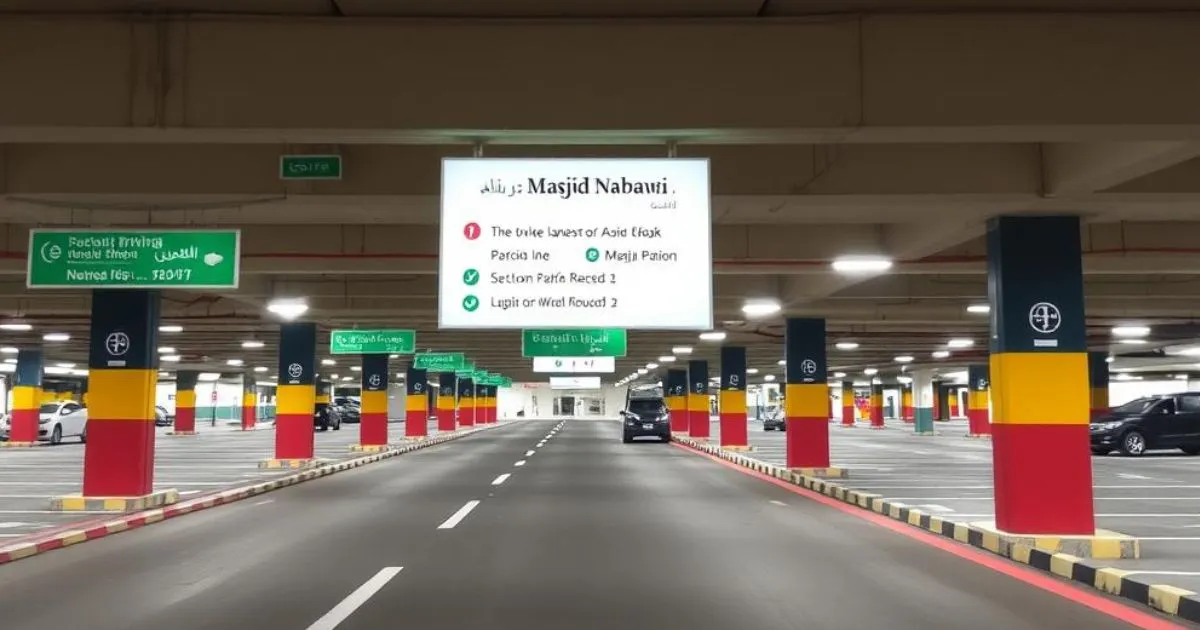
The main parking facility is located directly beneath the mosque complex and is the most straightforward option for visitors who want to park close to Al-Masjid an-Nabawi. The Saudi Ministry of Hajj and Umrah states that the underground parking can accommodate approximately 4,300 cars and is accessible through entrances connected to the main roads surrounding the mosque.
This guide focuses on what is useful for an independent visitor: where the main parking is, what is officially documented, and what other visitors have reported. It combines official information, firsthand observation, and visitor reports—with each category clearly identified.
Important: Parking arrangements, access routes, fees, and restrictions can change. Always follow the signs and instructions at the parking facility when you arrive.
Quick Facts
| Question | Answer |
|---|---|
| Is there parking underneath Al-Masjid an-Nabawi? | Yes. |
| Approximate capacity | 4,300–4,416 vehicles (official figures vary) |
| Number of access entrances | 4 main entrances (some official sources cite up to 6) |
| Where are the entrances? | Abu Bakr Al-Siddiq Road (north), Quba Road (south), Omar bin Al-Khattab Road (west), Prince Abdulmohsen Road (south) |
| Is the parking close to the mosque? | Yes. It is directly beneath the mosque complex. |
| Is parking free? | No. The underground facility is paid. Free parking options exist farther away, but are not officially designated. |
| Can I leave my car for several days? | Do not assume this is permitted. Check current rules before leaving a vehicle for an extended period. |
| Best practical tip | Record your parking unit and the pedestrian exit you use before walking toward the mosque. |
| Last verified | September 2026 |
Underground Parking Beneath Al-Masjid an-Nabawi
The principal parking facility for visitors arriving by car is located underneath Al-Masjid an-Nabawi.
According to the Ministry of Hajj and Umrah, the facility accommodates approximately 4,300 cars and has six entrances connected to the main roads around the Prophet’s Mosque.
An official Ministry guide provides additional detail, describing the parking as a two-level facility divided into 24 units: 11 on the upper level and 13 on the lower level. The same guide says that 12 units were allocated for annual and monthly subscriptions and 12 for hourly paid parking at the time of publication.
The General Authority for the Care of the Affairs of the Grand Mosque and the Prophet’s Mosque has since stated that the facility accommodates 4,416 vehicles across 24 units, each holding 184 cars. Other official figures cite approximately 4,200 cars. The variation reflects ongoing updates and different counting methodologies. The commonly cited figure of 4,300 remains a safe and accurate approximation.
Because parking arrangements can be modified, we recommend treating the current signs and instructions at the facility as the final authority rather than relying on an old parking map or an online description of a particular section.
A Useful Way to Think About the Parking
The underground facility is not simply one large open area where you can easily recognize your car later. It is divided into numbered units, and each unit has an upper (A) and lower (B) section.
Once you park, remember exactly where you left the vehicle.
Take a photograph of:
- Your parking unit number (e.g., Unit 4A, 7B)
- Nearby signs (which are in Arabic and English)
- The pedestrian entrance or exit
- Any floor or level indicator
This can save considerable time when returning, particularly after prayer when large numbers of visitors are leaving the mosque at the same time.
Which Entrance Should You Use?
Official sources describe the parking as accessible through four main entrances connected to the main roads around Al-Masjid an-Nabawi:
| Direction | Road | Entrance Point |
|---|---|---|
| North | Abu Bakr Al-Siddiq Road | Main northern access |
| South | Quba Road | Main southern access |
| West | Omar bin Al-Khattab Road | Main western access |
| South | Prince Abdulmohsen Road | Additional southern access |
This four-entrance structure is consistently reported by the Saudi Press Agency and the General Authority for the Care of the Affairs of the Grand Mosque and the Prophet’s Mosque.
Some older official sources mention five or six entrances, including a King Abdulaziz Road entrance on the eastern side. This discrepancy likely reflects changes in traffic management or the inclusion of secondary access points. When you arrive, follow the current signage rather than relying on a specific entrance count from an online source.
We do not recommend relying on an old online table that assigns individual parking sections to particular mosque gates or hotels. Internal pedestrian routes and access arrangements can change, and the official information currently available does not provide a sufficiently detailed public mapping of every parking unit to every mosque entrance.
Instead:
- Enter the parking facility from the road indicated by the current signs.
- Follow the parking signs once underground.
- Note your parking unit and level (e.g., 4A, 7B, 11A).
- When leaving the vehicle, photograph the nearest pedestrian exit.
- Follow the pedestrian signs toward the mosque.
If you are meeting family members later, agree on a specific meeting point rather than simply saying “meet at the parking.”
Parking Sections and Their Proximity to Mosque Gates
While official sources do not publish a complete unit-to-gate mapping, visitor reports and unofficial guides provide useful—if unverified—guidance. The following table synthesizes commonly reported associations. Treat these as practical leads, not official instructions.
| Parking Unit(s) | Reported Proximity | Notes |
|---|---|---|
| 1A, 1B | Near Makkah Gate (37) / Bilal Gate (38) | Useful for hotels in the southern area |
| 2A, 2B | Near women’s entrances and Rawdah access | Frequently cited for women’s prayer areas |
| 3, 4 | Near the Rawdah and Bab Al-Salam | Closest to the Prophet’s tomb area |
| 4A | Near Rawdah entry area | Visitor-reported as convenient for Rawdah |
| 5, 6, 7 | Western side, near Bab Al-Salam | Suitable for those arriving from the west |
| 6A, 8A | Near women’s prayer area | Visitor-reported for women’s access |
| 7A, 7B | Western section | Visitor-reported as near a women’s entrance |
| 8–11 | Northern side, near Bab King Fahd | Quick access to the northern courtyard |
| 12, 13 | Eastern side | Less used due to distance from most hotels |
| 11A, 11B | Northern/eastern side | Visitor-reported for certain gates |
These associations come from visitor discussions and unofficial guides. They are not official designations, and the actual pedestrian routes may differ. Always check the signs when you arrive.
Parking for Women
The relationship between parking sections and the entrances used by women is particularly useful for families to understand.
One visitor reported using the western underground parking, section number 7, and described it as being opposite an entrance used by women. Another visitor recommended 6A or 8A for those wanting to park near the women’s prayer area. A separate guide suggests that 2A and 2B are the closest parking areas to women’s entrances.
These are visitor reports rather than official parking maps, so we recommend treating them as practical leads rather than guaranteed current arrangements.
The important point is that the most convenient parking area depends on which part of the mosque you need to reach. Access arrangements can change, so check the signs and pedestrian routes when you arrive.
Official women’s entrances at Al-Masjid an-Nabawi include: Gates 12, 13, 14, 23, 24, 25, 26, 27, 28, 29, and 30. Women’s prayer areas are primarily located on the eastern and northern sides.
If you need a particular entrance because you are travelling with women, elderly family members, children, or someone with reduced mobility, ask the parking or mosque staff which pedestrian route is currently most suitable.
How Much Does Al-Masjid an-Nabawi Parking Cost?
Parking fees are an area where visitors should be careful with information found online. Older guides and visitor discussions quote specific hourly, daily, or subscription prices, but parking tariffs can change.
The most commonly cited current tariff (as of 2026) is:
| Duration | Rate (per hour) |
|---|---|
| First 2 hours | SAR 1.15 |
| Hours 2–8 | SAR 2.30 |
| Beyond 8 hours | SAR 3.45 |
All prices are subject to 15% VAT.
Payment can be made via:
- 48 self-payment kiosks located at unit entrances near the stairways
- QR code payment printed on your ticket
- The Mawaqif app on your smartphone
Check the current tariff displayed at the parking facility before leaving your vehicle. The official Ministry information confirms the existence and scale of the underground parking facility, while an earlier official guide describes both subscription-based and hourly-paid parking units. If you are visiting during a particularly busy season, check the current arrangements before your trip rather than assuming that a price found online several years earlier still applies.
Free Parking Near Al-Masjid an-Nabawi
Free parking is one of the most frequently asked questions, but it is also one of the easiest areas for online guides to become misleading. An empty space on a street does not necessarily mean that parking is officially permitted, and availability can change considerably depending on the time of day and local restrictions.
Bilal ibn Rabah Mosque Area
Several visitors in discussions we reviewed mentioned parking near Bilal ibn Rabah Mosque, which is approximately 800 meters from the Prophet’s Mosque near Gate 2.
One visitor specifically reported that there were four free parking areas beside the mosque and said that they left their vehicle there for four days while travelling to Makkah. Another comment independently identified the area near Bilal ibn Rabah Mosque.
This is useful visitor intelligence, but we have not independently verified that these spaces are currently designated free parking or that vehicles may officially remain there for several days. For that reason, we recommend describing this as a possible visitor-reported option rather than as an official free car park.
Other Free-Parking Reports
Free parking is one of the most frequently asked questions, but it is also one of the easiest areas for online guides to become misleading. An empty space on a street does not necessarily mean that parking is officially permitted, and availability can change considerably depending on the time of day and local restrictions.
Important Update (2026): Madinah has launched the Mawaqif Al Madinah smart parking project across several major roads, including Sultanah Road and Prince Abdul Mohsen bin Abdulaziz Road. During the pilot phase (until late September 2026), parking on these roads is free for users registered through the Mawaqif Al Madinah app. After the pilot, the fee will be SAR 3.45 per hour. If you plan to park on these roads, check the current status and register through the app.
Al Mughaisilah Area
Visitors have reported that free street parking may be available in the Al Mughaisilah district, a residential area north of the mosque. One source notes that “free street or nearby parking is available in the Al Mughaisilah area, but spaces may be limited during peak prayer times or weekends.”
This should be treated as a visitor-reported lead, not a guaranteed free lot. The area is a residential district, and parking rules may change. Verify signs carefully before leaving your vehicle.
Al Masaneh District
Al Masaneh is a known district with parking areas that visitors have used. It is farther from the mosque than the underground facility, and availability is generally better during peak periods.
However, the current fee status of parking in this district is unclear. Some areas may be free, while others may be metered or transitioning to the paid Mawaqif system. Check local signs and verify whether payment is required before leaving your vehicle.
Other Peripheral Areas
Visitors also mention other locations around Madinah, including areas near the hospital district and streets farther from the mosque. Some travelers report finding free street parking within walking distance, though availability is unpredictable.
We do not recommend publishing specific locations as guaranteed free parking unless their current status can be independently verified. If free parking is essential to your trip, allow extra time to find a legal space farther from the mosque and check local signs carefully.
A Note on Long-Term Parking
If you intend to leave your vehicle for several days while travelling to Makkah or elsewhere, do not assume that any street parking is officially permitted for extended periods. Visitor reports of multi-day parking exist, but they do not establish that such parking is officially allowed. Ask local authorities or your hotel for guidance, and check for signs indicating time limits or restrictions.
Is the Underground Parking the Best Option?
For visitors who prioritize predictability and proximity, the underground Al-Masjid an-Nabawi parking is generally the option to investigate first.
Advantages:
- It is directly beneath the mosque complex.
- It has a very large capacity (4,300–4,416 vehicles).
- It has multiple road entrances.
- Its existence and approximate capacity are documented by the Saudi Ministry of Hajj and Umrah.
- It offers direct access to the mosque courtyards via 112 electric stairs and 12 elevators.
- Dedicated parking spaces for persons with disabilities are allocated near entrances.
Disadvantages:
- The facility can become more difficult to navigate during busy periods.
- Finding a convenient space may take time.
- It is a paid facility.
Free parking farther away may save money, but it can involve a longer walk and greater uncertainty about availability.
When Should You Arrive?
Parking becomes more challenging when large numbers of visitors arrive at approximately the same time. For that reason, allow additional time if you are visiting:
- On Friday
- Around major prayer times
- During Ramadan
- During Hajj and Umrah peak periods
- During particularly busy religious seasons
Rather than trying to arrive shortly before the prayer, give yourself enough time to enter the parking facility, find a space, walk to the mosque, and reach the area where you intend to pray. This is especially important if you are travelling with elderly people, children, or someone who has difficulty walking.
Practical Parking Tips
1. Photograph your parking location
Before walking away from the car, photograph the parking number, section, level, and nearest pedestrian exit.
2. Do not rely only on your hotel name
A hotel may have several possible approaches from the surrounding roads. Use the current parking signs rather than assuming that the closest-looking road on a map is the correct entrance.
3. Give yourself more time than you think you need
During busy periods, the challenge may not be finding the mosque—it may be getting into the parking facility and then walking from the vehicle to the mosque.
4. Keep track of the pedestrian exit
The route back to your car can feel very different after prayer, when the mosque and surrounding streets are crowded.
5. Do not assume an online parking tip is still current
Parking entrances, restrictions, and access arrangements can change. This is particularly important for information copied from old blogs, social-media posts, or videos.
6. Ask staff if you are unsure
If you need a particular entrance because you are travelling with women, elderly family members, children, or someone with reduced mobility, ask the parking or mosque staff which pedestrian route is currently most suitable.
7. Use the Mawaqif app
The Mawaqif app allows you to pay for parking on your smartphone, which can save time when leaving during peak periods.
Frequently Asked Questions
Is there parking under Al-Masjid an-Nabawi?
Yes. The Saudi Ministry of Hajj and Umrah states that parking facilities underneath Al-Masjid an-Nabawi accommodate approximately 4,300 vehicles and are accessible through entrances connected to surrounding main roads. The General Authority for the Care of the Affairs of the Grand Mosque and the Prophet’s Mosque has also cited a capacity of 4,416 vehicles across 24 units, each holding 184 cars.
Is Al-Masjid an-Nabawi underground parking free?
No, the underground parking is a paid facility. The current indicative tariff is SAR 1.15 per hour for the first two hours, SAR 2.30 per hour for hours 2–8, and SAR 3.45 per hour beyond 8 hours, plus 15% VAT. Current charges should be checked at the facility.
Is there free parking near Al-Masjid an-Nabawi?
Visitors report finding free parking farther from the mosque, including around the Bilal ibn Rabah Mosque area (approximately 800 meters away). However, availability and parking rules can change, so these reports should not be treated as official parking designations.
Can I leave my car for four days?
Do not assume that you can. Individual visitors have reported doing so in other parking areas, but an individual experience does not establish that extended parking is officially permitted. Ask the parking operator about the current maximum permitted stay before leaving your vehicle.
Is there parking suitable for women visiting Al-Masjid an-Nabawi?
Yes, the underground parking provides access to the mosque area, but the most convenient pedestrian route depends on the current access arrangements. Visitors have reported that sections 6A, 7, and 8A are near women’s entrances. Treat these as visitor tips and follow current signage when you arrive.
How many cars can the underground parking hold?
Official figures range from 4,200 to 4,416 vehicles. The Ministry of Hajj and Umrah states approximately 4,300 cars. The facility comprises 24 units, each holding 184 vehicles.
How many entrances does the parking have?
Official sources describe four main entrances: Abu Bakr Al-Siddiq Road (north), Quba Road (south), Omar bin Al-Khattab Road (west), and Prince Abdulmohsen Road (south). Some older official sources mention up to six entrances, likely including secondary access points. Follow current signage when you arrive.
What payment methods are available?
You can pay via 48 self-payment kiosks at unit entrances, QR code on your ticket, or the Mawaqif app on your smartphone.
Our Recommendation
If you are driving to Al-Masjid an-Nabawi and want the most predictable option, start with the underground parking beneath the mosque rather than planning your trip around an unverified free parking space.
If you want to save money by parking farther away, treat free parking reports as leads rather than guarantees. Check the legality and current availability of any space before leaving your vehicle.
Most importantly, do not forget where you parked. Take photographs of the parking section, level, and pedestrian exit before walking toward the mosque.
How This Guide Was Verified
We separate information in this guide into three categories:
Official information:
Parking capacity, entrance roads, and the 24-unit structure are based on information published by the Saudi Ministry of Hajj and Umrah, the General Authority for the Care of the Affairs of the Grand Mosque and the Prophet’s Mosque, and the Saudi Press Agency.
Firsthand observation:
Parts of our practical advice are based on a firsthand inspection of the Al-Masjid an-Nabawi parking facilities.
Visitor reports:
Information about locations such as the Bilal ibn Rabah Mosque area, the reported use of particular parking sections, and women’s entrance proximity comes from visitor discussions. These reports are identified as such and are not presented as official instructions.
Parking arrangements can change. Check the signs and instructions at the facility when you arrive.
Last reviewed: September 2026
